
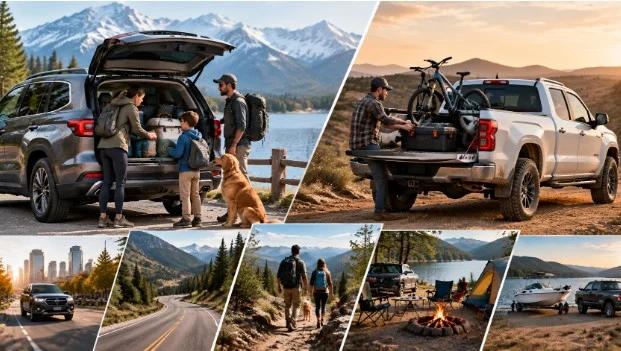
A vehicle used for everyday adventures needs to do more than get from one destination to another. Weekend camping trips, family outings, home improvement projects, road trips, and outdoor hobbies can all place different demands on a vehicle. That is why pickups and SUVs remain popular choices for drivers who want a combination of passenger space, cargo capacity, comfort, and capability.
However, choosing a practical vehicle is not simply about selecting the largest model available. The right option depends on how the vehicle will actually be used. Cargo requirements, passenger needs, driving conditions, fuel costs, towing plans, and available storage can all influence the decision. Understanding these factors makes it easier to identify the features that provide genuine everyday value rather than paying for capabilities that rarely get used.
1. Flexible Cargo Space Makes Adventures Easier
One of the biggest advantages of an SUV or pickup is the ability to carry more than a typical passenger car.
An SUV can provide a combination of passenger seating and enclosed cargo space, while a pickup offers an open bed that can accommodate bulky or messy items. For people who regularly transport bicycles, camping equipment, sports gear, tools, luggage, or home improvement supplies, that flexibility can make everyday errands much easier.
The key is to consider the type of cargo rather than simply measuring cargo volume.
For example, an SUV with folding rear seats may be ideal for someone who occasionally carries large boxes. A pickup may make more sense for someone who regularly transports landscaping materials, outdoor equipment, or items that would be inconvenient to place inside the cabin.
The right balance of passenger and cargo space can also be easier to evaluate by comparing different configurations. Drivers considering options at a Jeep dealership in Grapevine, TX can compare vehicle layouts based on how they expect to use the vehicle rather than focusing only on appearance or size.
2. Towing Capability Should Match Real Needs
Towing can be useful for everyday adventures, but maximum towing capacity should not be the only consideration.
Someone who occasionally pulls a small utility trailer has different needs from someone who regularly transports a boat, camper, or heavy equipment. A vehicle should have enough capacity for the expected load without being selected solely because it has the highest number in its class.
It is also important to account for passengers, cargo, trailer weight, and tongue weight. Adding people and equipment changes the overall load, so the practical towing capacity for a specific situation can differ from a vehicle’s advertised maximum.
This is especially important for drivers who expect their vehicle to handle both weekday transportation and weekend recreation. A suitable towing setup should support those activities without compromising normal usability.
3. Ground Clearance Helps With Varied Conditions
Everyday adventures do not always take place on perfectly maintained roads.
A trip to a campsite, trailhead, lake, or rural destination can involve gravel roads, uneven surfaces, mud, snow, or potholes. Ground clearance can provide useful additional space between the vehicle’s underside and obstacles on the road.
However, more clearance is not automatically better for every driver. A person who mainly drives in urban areas may have little need for extreme off-road capability. Meanwhile, someone who frequently travels on rough roads may place greater value on clearance, traction systems, and underbody protection.
The practical approach is to match the vehicle’s capability with the environments it will actually encounter.
4. Passenger Comfort Matters on Long Trips
Adventure-oriented vehicles still need to work as everyday transportation.
A vehicle may have excellent cargo capacity and towing ability, but if passengers are uncomfortable during longer journeys, its usefulness can be limited. Seating space, legroom, climate control, storage compartments, charging ports, and noise levels can all affect the experience.
Families should pay particular attention to second-row space and access. Adults who frequently ride in the back may need more legroom, while families with children may prioritize easy access for car seats and sufficient storage for personal items.
For couples or solo drivers, a smaller SUV may provide enough interior flexibility without the additional size of a three-row model.
5. All-Wheel Drive or Four-Wheel Drive Can Add Versatility
Traction becomes more important when driving conditions change.
All-wheel drive can be useful for drivers who encounter rain, snow, gravel, or other lower-traction surfaces. Four-wheel-drive systems may be more appropriate for drivers who regularly travel on challenging terrain or need additional low-speed traction.
These systems can add versatility, but they can also increase vehicle cost, weight, and complexity. Therefore, buyers should consider their typical driving environment instead of assuming that the most capable drivetrain is automatically the best choice.
A driver who spends most of the year commuting on paved roads may have different priorities from someone who regularly visits remote campsites or works in areas with difficult terrain.
6. Storage Solutions Improve Everyday Convenience
Practicality often comes down to small details.
An SUV with useful under-floor storage, adjustable cargo configurations, roof rails, and folding seats can make everyday organization easier. Pickups can offer bed storage systems, tie-down points, tonneau covers, and other accessories that help secure equipment.
Think about what tends to accumulate during a normal week.
Groceries, backpacks, work equipment, sports gear, emergency supplies, and outdoor equipment can quickly fill a vehicle. A well-designed storage layout reduces the need to stack items dangerously or sacrifice passenger space.
Good storage can also make spontaneous activities easier because commonly used equipment does not have to be rearranged every time it is needed.
7. Safety Features Are Part of Practicality
Safety should be considered alongside capability and convenience.
Modern pickups and SUVs can be equipped with features such as automatic emergency braking, blind-spot monitoring, lane-departure warnings, adaptive cruise control, parking sensors, and rearview cameras. The exact features vary by model and trim, so buyers should check the specifications of the particular vehicle they are considering.
These technologies can be particularly helpful when driving a larger vehicle. A wider body, longer wheelbase, or larger cargo area can change how the vehicle feels in tight parking spaces and crowded areas.
However, driver-assistance systems should supplement attentive driving rather than replace it.
8. Fuel Economy Still Matters
A practical adventure vehicle should also make sense during ordinary commuting.
It is easy to focus on weekend capability and overlook the fact that the vehicle may spend most of its time traveling to work, school, stores, or appointments. Fuel economy can therefore have a meaningful effect on long-term ownership costs.
Consider the typical balance between capability and daily mileage. A driver who travels long distances every week may benefit from prioritizing efficiency, while someone who drives relatively few miles may place greater emphasis on cargo capacity or towing.
The goal is not necessarily to find the most efficient vehicle or the most powerful one. It is to find a combination that fits the majority of driving situations.
9. Easy Handling Makes a Larger Vehicle More Usable
Size can be useful, but too much size can become inconvenient.
A practical pickup or SUV should feel manageable in the places where it will normally be driven. Parking dimensions, turning radius, visibility, steering feel, and camera systems can all influence how comfortable a driver feels behind the wheel.
This matters especially for people who switch between open roads and crowded urban environments.
During a test drive, it is worth evaluating more than acceleration. Try parking, making tighter turns, checking visibility, and getting in and out of the vehicle. These simple experiences can reveal whether the vehicle’s dimensions work for everyday routines.
10. Think About How the Vehicle Will Age With Your Needs
A vehicle purchase is rarely based only on today’s requirements.
A driver’s needs may change over several years. A growing family, new hobbies, additional commuting requirements, or a change in recreational activities can all affect how much space and capability are needed.
That does not mean buyers should purchase far more vehicle than they currently need. Instead, it can be useful to leave some reasonable room for changing circumstances.
For example, someone who currently travels alone but expects to take regular family trips may value flexible seating. Someone who recently started camping may want enough cargo space for equipment without immediately needing a heavy-duty pickup.
Thinking ahead can help prevent the vehicle from becoming impractical soon after purchase.
Conclusion
The most practical pickup or SUV is not necessarily the biggest, most powerful, or most heavily equipped option. Practicality comes from having the right combination of cargo flexibility, passenger comfort, traction, towing ability, safety features, storage, efficiency, and manageable dimensions.
The best choice depends on how those capabilities fit into everyday life. By considering actual driving conditions, typical cargo, passenger needs, recreational activities, and future plans, drivers can focus on features that provide useful value both during weekday routines and weekend adventures.
FAQs
1. Is an SUV or pickup better for everyday adventures?
It depends on the type of activities involved. SUVs generally provide enclosed cargo space and comfortable passenger seating, while pickups offer an open bed for bulky or messy equipment. The better option is the one that matches the driver’s typical cargo, passenger, towing, and travel requirements.
2. What features should I prioritize in an adventure vehicle?
Start with the features you will use most often. Flexible cargo space, comfortable seating, appropriate ground clearance, useful storage, safety technology, and suitable drivetrain options are practical priorities. If towing is important, also compare the vehicle’s specific towing and payload ratings rather than relying only on general model-level figures.
3. Does a vehicle need four-wheel drive for outdoor trips?
Not necessarily. Many outdoor destinations can be reached without four-wheel drive, particularly when roads are paved or well maintained. However, drivers who regularly encounter mud, snow, loose surfaces, steep terrain, or difficult trails may benefit from additional traction capability. The choice should reflect actual driving conditions.