
Have you ever been texting a friend and suddenly saw “DW” pop up, leaving you scratching your head? 🤔 Don’t worry — you’re not alone!
Texting abbreviations have exploded in the digital age, and understanding them is key to keeping your conversations smooth and fun.
In this guide, we’ll explore everything about DW meaning in text, its origin, usage, examples, and even some expert tips on using it correctly.
What Does DW Mean in Text? 💬
In texting, DW stands for “Don’t Worry”. It’s a short, casual way to reassure someone that everything is okay or that they shouldn’t stress about a situation. This abbreviation is widely used in chats, social media platforms, and even emails among friends and colleagues.
Key Uses of DW
- Reassurance: Telling someone not to stress over a problem.
- Casual Conversations: Makes messages quicker and friendly.
- Texting Efficiency: Saves time and space in fast messaging.
The Origin of DW 📜
The abbreviation DW emerged with the rise of instant messaging platforms like MSN Messenger and early social media. Users sought shorter ways to communicate emotions and instructions. Just like other acronyms such as LOL (Laugh Out Loud) or BRB (Be Right Back), DW became a standard shorthand in texting culture.
DW vs Other Similar Abbreviations 🔄
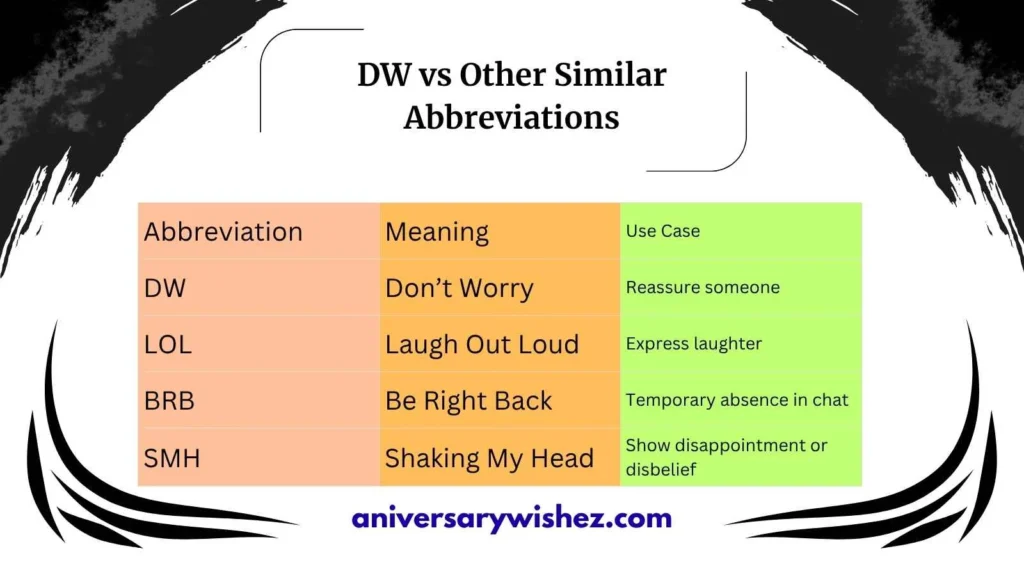
While DW is simple, there are other similar texting abbreviations that sometimes confuse people. Here’s a quick table to clarify:
| Abbreviation | Meaning | Use Case |
|---|---|---|
| DW | Don’t Worry | Reassure someone |
| LOL | Laugh Out Loud | Express laughter |
| BRB | Be Right Back | Temporary absence in chat |
| SMH | Shaking My Head | Show disappointment or disbelief |
Examples of DW in Text Messages ✉️
Seeing DW in context helps you understand its tone and usage. Here are some real-world examples:
- Friend 1: “I forgot to bring the book 😬”
Friend 2: “DW, I’ll bring it tomorrow!” - Colleague: “I messed up the report 😅”
You: “DW, we can fix it before the meeting.” - Partner: “I’m running late 💨”
You: “DW, take your time ❤️”
Why DW is Popular in Modern Texting 🌟
The popularity of DW comes from its simplicity and emotional effect. People love quick communication that also provides comfort. Here are some reasons it’s widely used:
- Quick Reassurance: No need for long sentences.
- Friendly Tone: Keeps conversations casual and approachable.
- Global Understanding: Recognized in English texting worldwide.
DW in Social Media & Chat Platforms 📲
DW isn’t limited to SMS. You’ll see it everywhere:
- Instagram Comments: “DW, you’ll nail it! 💪”
- WhatsApp Chats: “Missed your call? DW, I’ll call later.”
- Discord & Gaming Chats: “DW, we’ve got your back in the game!”
How to Use DW Professionally 🏢
Although DW is casual, it can be adapted for professional contexts if used carefully:
- Email: “DW, we’ll resolve this issue today.”
- Team Chats: “DW, the deadline is manageable.”
- Client Messages: Only if the relationship is informal.
Common Mistakes When Using DW ❌
Even simple abbreviations can cause misunderstandings. Avoid these pitfalls:
- Overusing DW: May seem dismissive if used too often.
- Wrong Tone: Don’t use in serious or formal complaints.
- Assuming Everyone Knows: Some users may not be familiar with texting acronyms.
DW and Emotional Context ❤️
DW isn’t just words — it carries emotional weight. Using it correctly shows empathy and understanding. For example, pairing DW with emojis like 😊, 💕, or 👍 makes it warmer and more genuine.
Regional Variations 🌍
While DW is mostly understood in English texting communities, some regions may have alternative ways to express “don’t worry”:
- UK & US: DW (Don’t Worry)
- Spain: “No te preocupes” or NTTP in chats
- France: “Ne t’inquiète pas” often abbreviated as NTP
Fun Facts About DW 🧐
- DW is often used in memes to comfort or reassure humorously.
- It appears frequently in teen texting language but is also widely understood by adults.
- DW has become a part of digital etiquette, showing care without long messages.
Other Texting Abbreviations You Should Know 📝
If you’re learning DW, it helps to know related abbreviations:
- FYI: For Your Information
- IMO: In My Opinion
- TMI: Too Much Information
- BTW: By The Way
Interactive Table: DW vs Other Abbreviations 📊
| Abbreviation | Meaning | When to Use |
|---|---|---|
| DW | Don’t Worry | Reassure someone |
| FYI | For Your Information | Share information |
| BRB | Be Right Back | Temporary absence |
| IMO | In My Opinion | Give opinion casually |
Tips for Using DW Like a Pro 🌟
- Always match the tone of your conversation.
- Use emojis to convey warmth.
- Pair DW with positive reinforcement: “DW, you’ll do great!”
- Don’t replace DW with long sentences; keep it simple.
FAQs
1. Can DW be used in professional emails?
Yes, but only in informal contexts or with colleagues you’re comfortable with. Pairing it with polite language is key. Example: “DW, we’ll handle this issue promptly.”
2. Is DW used globally?
DW is mostly understood in English-speaking countries, but the idea of “Don’t Worry” exists in most languages with local abbreviations.
3. Does DW carry a casual tone?
Absolutely. DW is friendly and casual. It’s ideal for friends, family, and informal chats.
4. Can DW be misunderstood?
Yes, especially if the recipient isn’t familiar with texting acronyms. Always consider your audience.
Conclusion
Texting abbreviations like DW make digital communication faster, friendlier, and emotionally expressive.
By understanding its meaning, origin, usage, and context, you can use DW confidently in both casual and semi-professional conversations.
Remember to pair it with empathy, emojis, and the right tone to maximize its impact. 💡

I am passionate about exploring the meanings behind words, phrases, and expressions. Through my work, I aim to simplify language and help readers understand communication in everyday life. Writing about meanings allows me to share knowledge and connect people with the power of words