

Stepping into a law school lecture hall for the first time is often a humbling experience. Unlike undergraduate courses in humanities or social sciences—where writing revolves around defending an opinion, summarizing literature, or discussing broad theories—legal education requires a complete reset of how you think, read, and write. The shift from general academic writing to legal analysis is notorious for catching students off guard.
When professors assign case-based assignments, they are not testing your ability to memorize statutory sections or write lengthy essays filled with decorative vocabulary. Instead, they are evaluating how effectively you can act as a legal researcher, apply abstract doctrines to messy real-world scenarios, and formulate sound legal reasoning. Balancing this specialized discipline alongside general coursework, part-time work, and extracurricular commitments can quickly become overwhelming. During particularly heavy assessment periods, taking advantage of structured assignment help can give students the clarity needed to organize their schedules, break down complex study materials, and maintain academic momentum without burning out.
To conquer case-based legal tasks consistently, you need a repeatable system. Mastering this format comes down to understanding what legal markers look for, organizing your arguments systematically, and executing precise analysis.
Understanding the Essence of Case-Based Legal Tasks
Before diving into research or typing out a single paragraph, it is crucial to understand what a case-based assignment actually asks of you. Unlike a standard essay that explores a broad question, a legal problem question presents a hypothetical set of facts involving parties in a dispute. Your job is to act as an objective advisor or advocate, identifying actionable legal issues, determining which rules govern those issues, and predicting how a court would decide.
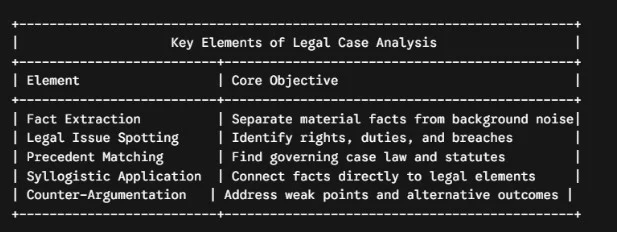
Students often struggle because legal facts are deliberately written with subtle nuances. A minor detail—such as whether an offer was communicated by post or email, or whether a statement was made casually over coffee versus in a business meeting—can completely change the legal outcome. Your first read-through of a problem question should focus solely on mapping out the timeline of events and identifying the relationships between the entities involved.
Step 1: Fact Extraction and Issue Spotting
The most common trap for law students is reading a problem scenario and immediately jumping to a conclusion. This leads to missing crucial sub-issues that carry substantial marks. A structured, three-phase reading approach ensures you capture every layer of the problem.
1. The Initial Narrative Skim
Read the problem scenario from start to finish without taking notes. The goal here is simple: grasp the overall storyline, identify the key players, and understand who is suing whom, who is facing criminal charges, or who is seeking legal remedies.
2. The Granular Fact Audit
Read the scenario a second time, highlighting specific facts, dates, monetary amounts, and verbal exchanges. Ask yourself these core questions:
- What specific harm or loss has occurred?
- What duty was owed between the parties?
- Did any action or omission breach that duty?
- Are there any factual assumptions that need clarification?
3. Framing the Legal Issues
Transform your factual observations into precise legal questions. Instead of stating, “John owes Mary money for the broken contract,” frame the issue using formal legal language: “Whether John’s statement constituted a binding offer or a mere invitation to treat.” Precise issue framing shows your evaluator immediately that you understand the underlying legal mechanics.
Step 2: Conducting Targeted Legal Research
Once you have identified your legal issues, you must support your claims using primary authority: statutes (legislation) and case law (judgments). Blindly searching legal databases often leads to information overload, leaving you with dozens of irrelevant cases.
Start by consulting leading textbooks or practitioner guides to understand the general principles governing your issue. Once you have a firm grasp of the core doctrines, move to specialized legal databases to locate the exact authority you need.
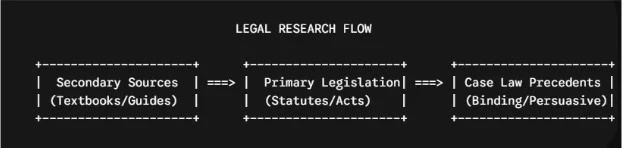
When building your legal foundation, ensure you distinguish between binding precedent (decisions from superior courts in your jurisdiction) and persuasive precedent (decisions from lower courts or parallel jurisdictions). Citing high-level court judgments carries significantly more weight in your analysis.
Because mastering doctrinal frameworks, judicial reasoning, and precise citation standards requires dedicated effort, utilizing specialized law assignment help from experts at Myassignmenthelp can help you learn how to evaluate complex precedents, format case citations correctly, and structure arguments that meet university expectations.
Step 3: Mastering the IRAC Framework
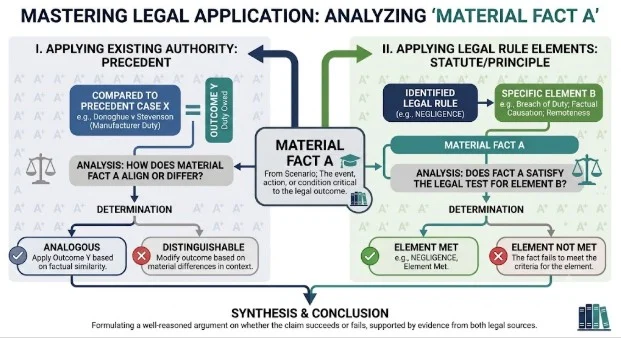
The standard structure for answering legal problem questions across global universities is the IRAC method (Issue, Rule, Application, Conclusion). While the formula seems straightforward, the key to scoring top marks lies in how deeply you execute the Application stage.
Issue (I)
State the legal issue clearly and concisely. Avoid dramatic openings or general background statements. Get straight to the point by framing the precise question of law the court must resolve.
Rule (R)
State the governing legal principles, citing relevant statutes and binding case law. State the ratio decidendi (the legal reason for the decision) of the cases you rely on. Avoid summarizing entire factual backgrounds of past cases unless the facts are directly analogous to your problem scenario.
Application (A)
This section forms the core of your assignment and accounts for the majority of your grade. Here, you weave your facts directly into the elements of the legal rule.
- Compare and contrast the facts of your scenario with established precedents.
- Use words like “Analogous to…”, “Distinguishable from…”, or “Applying the principle in…”
- Address potential counter-arguments. Acknowledge weak points in your client’s position and explain how a court might interpret those ambiguities.
Conclusion (C)
Summarize your findings in one or two definitive sentences. Provide a clear recommendation or outcome based strictly on your application section. Avoid introducing new facts, authorities, or ungrounded opinions here.
Common Pitfalls in Legal Writing and How to Avoid Them
Even well-researched law papers can lose marks due to poor structural habits or weak analytical execution. Here are the most frequent mistakes students make and how to fix them:
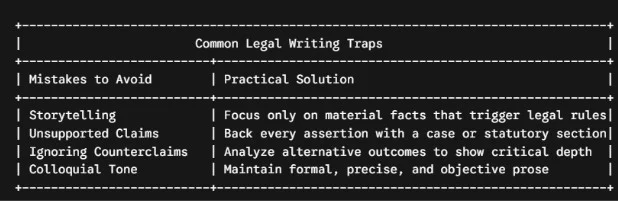
1. Excessive Storytelling
Do not spend pages retelling the scenario facts back to your lecturer. They already know the facts. Focus your space entirely on legal analysis and applying rules to those facts.
2. Asserting Conclusions Without Authority
Never state a rule of law without citing its legal origin. Saying “Contracts require consideration to be valid” without citing foundational authority weakens your academic rigor. Every legal principle requires a source anchor.
3. Over-Reliance on Direct Quotes
Avoid filling paragraphs with long, copied passages from legal judgments. Lecturers want to see that you understand the court’s reasoning well enough to synthesize it into your own words, supported by accurate parenthetical citations.
Final Review: Refining Your Draft Before Submission
Writing a legal assignment is an iterative process. Your initial draft focuses on getting the legal logic down on paper; your revision phase focuses on precision, clarity, and authority.
- Check Your Transitions: Ensure each paragraph flows logically into the next. Use transitional phrases that signal legal reasoning, such as “Consequently,” “Furthermore,” “In contrast to,” or “Accordingly.”
- Audit Your Citations: Verify that every case name, volume number, law report identifier, and section reference is formatted correctly according to your university’s required style guide (e.g., OSCOLA, AGLC, Bluebook, or APA).
- Read Aloud for Objectivity: Read your analysis out loud to test its tone. Ensure your conclusions sound balanced, objective, and well-supported rather than emotional or argumentative.
By approaching case-based assignments as systematic analytical puzzles rather than creative writing exercises, you will consistently produce well-structured, authoritative, and top-tier legal papers throughout your university journey.
Frequently Asked Questions (FAQs)
Q: What is the IRAC method, and is it mandatory for all law assignments?
Ans: IRAC stands for Issue, Rule, Application, and Conclusion. It is the universally accepted framework for resolving legal problem scenarios. While some universities prefer slight variations like MIRAT (Material Facts, Issue, Rule, Application, Tentative Conclusion) or CREAC (Conclusion, Rule, Explanation, Application, Conclusion), the fundamental logic remains identical: identify the problem, state the governing authority, apply it to the facts, and reach a reasoned conclusion.
Q: How do I determine which facts are material in a legal problem scenario?
Ans: A fact is considered material if changing or removing it would alter the legal outcome of the case. To test whether a fact is material, ask yourself if a specific legal rule or element depends on that detail. If a detail only serves as narrative background (such as the color of a car in a standard breach of contract claim), it is likely immaterial.
Q: How many legal precedents should I cite per issue?
Ans: Quality always trumps quantity in legal writing. Rather than listing ten cases that state the same broad principle, focus on citing the leading or foundational case alongside one or two recent judgments that apply the principle to facts similar to your assignment scenario. Citing two well-analyzed precedents is far more effective than dropping multiple case names without explaining their relevance.